
HaloSync Open Sources an AI Stack for Faster OTA Integration and Smarter Operations
For OTAs, airline API integration is still far from simple. NDC has opened the door to richer airline content, ancillary services, and more direct distribution, but the reality on the ground remains highly complex. Different authentication methods, inconsistent request structures, and long workflows spanning shopping, booking, ticketing, changes, and refunds create significant pressure for both engineering and operations teams.
This challenge goes far beyond connectivity. In practice, OTAs are dealing with a combined problem of delivery speed, operational efficiency, maintenance cost, and time to market. Engineering teams need to align frontend and backend data models, handle carrier-specific exceptions, and build secure server-side integration layers. At the same time, operations teams are often left managing repetitive tasks such as order retrieval, seat changes, ancillary additions, itinerary changes, and refunds across fragmented systems and manual workflows.
HaloSync looks at this challenge through an AI lens. We believe AI should do more than accelerate coding. It should make API integration faster and easier, while also improving how OTA teams operate every day. This open-source release is intended to make that direction tangible through working architecture and implementation references.
HaloSync currently supports onboarding through direct contact, and we also plan to open a Self Onboarding service so OTAs can start Sandbox access and initial integration setup more directly on their own. That experience is already in progress, with the goal of helping more customers get connected to HaloSync in less time. This open-source release is an important step toward that future.
A Foundation for Faster, Easier API Integration
This release includes three repositories. Each one is useful on its own, but together they form an AI-enabled execution stack for OTAs.
whitelabel-client: a multi-tenant whitelabel frontend generation platform that helps OTAs launch branded flight booking websites quickly. According to the README, it generates a Vite + React static SPA, provides a sandbox demo atdemo.halosync.kr/demo, and supports the full booking lifecycle from shopping and booking to seat selection, ancillaries, and post-booking flows.whitelabel-middleware: a NestJS-based middleware gateway for the PolarHub NDC API. The README highlights HMAC-SHA512 signing, frontendcamelCaseto PolarHubPascalCasetransformation, carrier-specific error handling, and Swagger-based verification flows. It also includes a runnable sample server with 10 API endpoints.polarhub-mcp-client: an AI client built on Model Context Protocol (MCP), designed to handle search, booking, seat selection, ancillary services, itinerary changes, and refunds through natural language. The README positions it as an MCP reference implementation with multi-LLM support and production-grade session management for multi-step booking workflows.
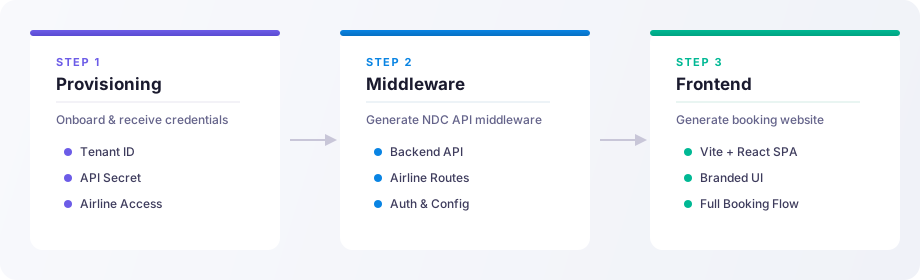
These repositories are more meaningful together than separately. whitelabel-middleware reduces the burden of API integration, whitelabel-client shortens time to launch, and polarhub-mcp-client simplifies operational workflows that are often repetitive and complex. Together, they form a practical open-source reference for solving two of the most persistent OTA challenges at once: difficult integration and inefficient operations.
An AI Interface for More Efficient Operations
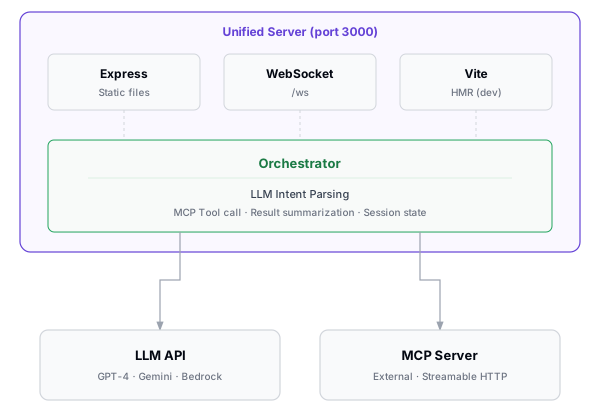
polarhub-mcp-client in particular shows HaloSync’s direction for AI-driven operational interfaces. MCP is a standard interface that helps LLMs call external tools in a consistent way, and HaloSync uses that model to make complex booking and post-booking tasks accessible through natural language. The key point is not the chatbot itself. The real value is making operational work faster and more intuitive, even when users do not fully understand the underlying APIs or internal system structure. That creates a foundation for higher productivity, fewer repetitive tasks, and more efficient execution with leaner teams.
AI Can Improve Both Delivery Speed and Operational Efficiency
HaloSync will continue building travel infrastructure that is easier to connect, faster to launch, and more efficient to operate. The Self Onboarding experience now in progress is intended to accelerate that direction even further. Over time, OTAs will be able to get started more easily, validate faster, and move into production operations in less time.
Explore HaloSync’s open-source repositories on GitHub:
Access to the PolarHub API is currently provided through a separate onboarding process, and a more streamlined Self Onboarding experience is planned for the future. These repositories offer a practical starting point for OTAs evaluating architecture, implementation patterns, and AI-powered operational workflows. For onboarding and partnership inquiries, please contact contact@halosync.kr.